


Newsletter 203 – 02.02.2026
Argentina has a long fruit growing tradition. Many immigrants, mostly from the Mediterranean region, and later joined by those from central and northern Europe, brought with them a solid culture of fruit cultivation and found regions in the country suitable for their development. Production was primarily aimed at supplying the domestic market. Over time, industrialization gained relevance, absorbing fruit not suitable for fresh consumption. Thus, the export of fresh fruit, with few exceptions, always occupied a secondary place.
This trend has deepened in the last twenty years as a consequence of unfavorable policies for fruit growing and the export of its products. Without support policies it is very difficult to sustain modern fruit growing, incorporate the necessary technology to compete internationally and offer the market the quality that consumers demand today.
Another factor that negatively affected the fruit industry is its low relative weight within Argentine foreign trade. The country's main foreign exchange generators are oilseeds, grains, hydrocarbons and mining. In a context of recurring economic crises and risk of default, the country tends to prioritize the sectors that contribute the greatest foreign exchange income, relegating regional economies. In this way, the importance of fruit growing as a generator of employment, social support, provider of healthy foods and guarantor of the sustainability of agricultural ecosystems is subordinated to emergency situations. Added to this is that the crises led to an increase in tax pressure and a greater complexity of the labor system. This whole set of factors caused a progressive increase in the so-called “Argentine cost”, a loss of competitiveness and a sharp drop in exports. As a representative of the export sector expressed after a presentation on the situation of Argentine fruits in the world: “You have to be Superman to be successful in exporting”.
Only two products managed to sustain a certain level of exports: pears and lemons. Both have international competitive advantages and are produced on a larger scale, allowing for a relatively more favorable cost structure. However, its placement in the external market is essential, since the internal market is not able to absorb the volumes produced.
In 2022 and 2023, a historic low was reached, with total exports less than half of those registered a decade ago. The assumption of Javier Milei's government implied a significant change in economic policy. On the one hand, inflation was managed to slow down, which had reached levels close to hyperinflation; On the other hand, public spending was reduced and progress was made in normalizing the economy, allowing greater predictability and planning capacity. This new macroeconomic framework was favorable for the sector, although it did not translate into a substantial improvement in the fruit economy. A high tax burden, a complex and unfavorable labor system, high logistics costs and the lack of bilateral negotiations that facilitate international trade persist. In this context, it is not surprising that exports have only recovered slightly and that the “Argentine cost” remains high. There is still a long way to go, compounded by the fact that the current government does not consider fruit growing as a priority sector and shows limited understanding of its complexity.
One of the changes introduced by the new government, in line with the policy promoted by President Milei, was the opening of the local market to imported products. The objective is to increase competition and force the national product to improve its competitiveness and quality. However, this opening took place before reducing the tax burden on producers, lowering internal costs and implementing a labor reform. As a result, the local producer faces unfair competition, having to compete with products from countries with considerably lower cost structures. In this scenario, it is not enough to improve productivity or efficiency, since many of the costs do not depend on the producer and are excessively high.
As a consequence of the national government's trade opening, imports skyrocketed. Bananas concentrate the majority of these external purchases. It is worth remembering that Argentina knew how to have significant banana production, but apathy, conflicting interests and the absence of support policies led to a sharp reduction in production. At the same time, imports of other fruits also grew steadily, such as avocados, lemon-limes, pineapples, grapes, kiwis, apples, and cherries, among others, which compete directly with local production and reduce their space in the domestic market.
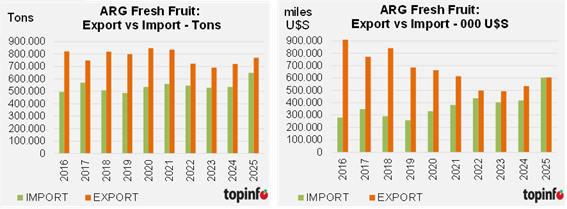
Foreign trade statistics clearly reflect this problem. While exports barely showed a slight recovery, imports skyrocketed, to the point that in 2025 the imported value equaled the exported value. In terms of volume, exports still exceed imports, given that their unit value is lower. Traditionally, Argentina was a purely exporting country; However, for the first time this condition is diluted, becoming also a fruit importing country.
Authors: Ing.Agr. Betina Ernst