

Newsletter 189 – 07.07.2025
A new successful season has finished, with the Southern Hemisphere exporting 1.78 million tons. This is 24-26% more than in the last 5 years, when the export was about 1.5 million tons. If we compare this to the situation 10 years ago, this means an increase of 40%. All countries increased their shipments, but the most significant increase in the current season was given by Peru, which after a decline in 2023/24 not only recovered its volumes, but exceeded it reaching a new export record of 680,000 tons. Therefore, Peru represents almost 40% of what exported by the hemisphere. It is followed by Chile that participated with 31% and South Africa with 20%. Australia and Brazil are minor suppliers..
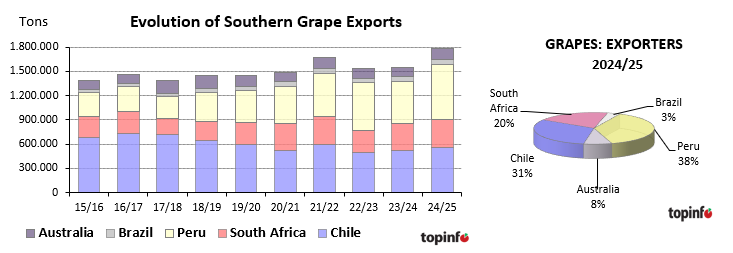
This successful result was achieved thanks to adequate planning, projection and efforts made by all the members of the supply chain. Here we will detail some of these achievements.
Varietal changes
The southern export began about 30 years ago with the new varieties of that time; with no seed, large berries, which could endure the boat trip and arrived with good quality and condition to external markets. Such was the case of Thompson or Flame Seedless. For many years these varieties were guarantee of success. But in the last 10 years with the emergence of patented varieties, the preference of northern consumers changed. The new varieties were more attractive, with intense flavor, color uniformity, long shelf life and greater resistance to pests and diseases. The new plantations, such as those carried out in recent years in Peru, began with these varieties. This change in the case of the producers and regions that already had a large surface of grapes was quite more difficult. In these cases, the replacement with varieties that demanded the payment of royalties was not easy and meant a great investment. For this reason, countries with expanding table grape production had better capacity join the new world of patented grapes.
Such was the case of Peru, which passed in the last 5 years of exporting 50% of patented, to 76% in the last season. In South Africa the overturn was even greater, to export 67% of patented in 2020/21, to 76%. In contrast Chile and also the Mediterranean countries took longer to take that step. 5 years ago the patented participated in a third of Chilean exports, and currently are two thirds (65%).
Planting new varieties leads to a challenge for the producer, since at the time of deciding on some aspects of it are unknown, such as adaptation to the agroclimatic conditions of the place, as well as its behavior in the market. So there were cases of success, but also failures. In the White group the most widespread today are the Sweet Globe, Autumn Crips, Land 15, Timpson, Ivory, Early Sweet, Sugar Crips, Cotton Candy; within the red ones, Allison, Sweet Celebration, Timco, Jack Salute, Scarlotta and Starlight; and among the black ones Sable, Sweet Joy, Sweet Favors and Sugarthirteen stand out.
Diverse destinations
When the southern grape trade began, there were just two markets in the mind, Europe and the US. These received 80% of shipments. Chile prioritized in their shipments to the US, South Africa to Europe. But as the business evolved, new suppliers emerged, the volumes increased and the need to conquer new markets arose. It was these new destinations that allowed the greatest growth of trade. Within these, Asia stands out, a continent that currently receives 20-25% of southern grapes. Within the Asian regions, the Far East is first with China. But also Japan and South Korea appreciate the southern grapes and their imports are growing. Another region of increasing importance is Southeast Asia. Peru, Chile and Australia are betting strongly to them. Meanwhile the Middle East supply is dominated by South Africa.
On the other hand, Peru, Chile and Brazil have discovered Latin American as an alternative destination to take into account. Within this continent the main importers are Brazil, Colombia, Argentina and Central America.
North America and Europe are still the first destinations and are receiving higher volumes than 10-20 years ago; but this growth was lower than in the case of the new markets. For this reason, its participation within the total exported by the Southern Hemisphere was reduced. 20 years ago he received 80% of the Shouthen total, but now this is only 65%.
Supermarkets chains
Part of the success of the southern grape was thanks to its incorporation into the big retail chains. These seek to ensure grape supply throughout the year. Especially during the long winters when other fresh fruits are not available, southern grapes is the perfect complement. Thus, grapes stopped being a seasonal fruit to be present throughout the year.
What facilitated its incorporation into large stores is its presentation in trays or bags of 500-600 g, wich are easy to manipulate. Another fundamental fact is to have extended its useful life for several weeks, which allows it to transport it by boat, distribute it correctly and have enough time to sell them.
With this qualities, this fruit is ideal for ads. Grapes are one of the key fruits to include it in the ads and thus attract customers. In the US it is always within the 10 most promoted fruits. Participates in 10-20% of the weekly ads. Normally it is the second most announced fruit, behind apples. But there are moments where it is in the first place. A similar situation occurs in Germany. Normally between 20 to 70 chains they promote them, almost always in the first places of the most offered fruits.
Authors: Ing.Agr. Betina Ernst